
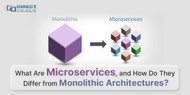
What Are Microservices, and How Do They Differ from Monolithic Architectures?
Published by Admin on March 18, 2026
In the rapidly evolving world of software development, choosing the right architecture is a crucial decision for businesses aiming to stay competitive, agile, and future ready. Two architectural styles that frequently dominate conversations are Microservices and Monolithic Architectures. While both have their unique strengths and challenges, understanding their core differences can significantly influence a project’s long term success.At DirectDeals, we’ve spent the last 27+ years building trust with our customers by offering reliable technology solutions tailored to their needs. Whether you're launching a new software product or modernizing an existing application, understanding architectural choices is vital and we're here to help you make the right one.
What is Monolithic Architecture?
A monolithic architecture is the traditional approach where all components of an application user interface, business logic, and data access are combined into a single codebase and deployed as one unit. This design works well for small applications or startups in the early stages.
Advantages of Monolithic Architecture
Simplified development: A unified codebase makes it easier to get started.
Easier debugging: Everything is centralized, making it simple to track bugs.
Straightforward deployment: Only one deployable file or service to manage.
Drawbacks
Scalability issues: You can't scale parts individually only the entire application.
Slow development: Teams must coordinate heavily to avoid conflicts.
Tightly coupled components: A small change can ripple across the entire system.
What are Microservices?
Microservices architecture breaks down an application into small, autonomous services. Each service handles a specific business function and can be developed, deployed, and scaled independently. These services typically communicate via RESTful APIs or messaging queues.
Benefits of Microservices
Modularity: Easier to maintain, update, and debug.
Technology diversity: Different services can use different programming languages or frameworks.
Independent scaling: Scale only the services that need it.
Fault isolation: Failures in one service don’t bring down the entire application.
Challenges of Microservices
Complex deployment: Managing multiple services simultaneously can be complicated.
Increased overhead: Requires orchestration tools and monitoring systems.
Testing difficulties: Inter service communication must be thoroughly tested.
Monolithic vs Microservices: A Clear Comparison
| Feature | Monolithic | Microservices |
|---|---|---|
| Architecture | Unified, single codebase | Decentralized, modular services |
| Deployment | One unit | Independently |
| Scalability | Entire app scales | Component level scalability |
| Maintenance | Tightly coupled code | Loosely coupled and easier to update |
| Technology | Single stack | Multiple technologies possible |
| Failure Handling | Risk of full crash | Isolated failures |
Why Are Microservices So Popular Today?
With the rise of DevOps, containerization (Docker, Kubernetes), and cloud native development, microservices have become the go to architecture for enterprises aiming for speed, scalability, and innovation. They empower teams to work independently, iterate quickly, and deliver value to customers faster.At DirectDeals, we have seen firsthand how businesses can transform their legacy applications into modern, scalable systems using microservices. With 27+years of trust in the IT industry, we help companies make smart, strategic architectural choices that align with their growth objectives.
Conclusion
While monolithic architectures are simpler and often suitable for small-scale applications, microservices provide the agility, scalability, and fault tolerance needed for modern, large-scale software systems.Choosing between the two comes down to your project’s complexity, future plans, team structure, and business goals. At DirectDeals, we’re committed to guiding you through that choice with expertise, transparency, and dedication.
Let DirectDeals Guide You Through Your Digital Transformation
Whether you’re starting fresh or planning to migrate from a monolithic setup to a microservices-based ecosystem, our team is here to provide the tools, consultation, and ongoing support you need. With over two decades of experience and thousands of satisfied clients, DirectDeals is your trusted technology partner.
Phone: +1-800-983-2471
Email: support@directdeals.com
Website: www.directdeals.com
Build smarter. Scale faster. Choose the architecture that grows with you. Choose DirectDeals.
}
.microsoft-visio {
border: solid 1px #ccc;
text-align: left;
margin-top: 20px;
width: 100%;
}
.microsoft-visio thead th {
border-right: solid 1px #ccc;
padding: 15px;
}
.microsoft-visio thead th p {
margin-bottom: 0px;
}
.microsoft-visio tbody tr td {
border-top: solid 1px #ccc;
border-right: solid 1px #ccc;
padding: 15px;
}
.microsoft-visio tbody tr td p {
margin-bottom: 0px;
}
.microsoft-visio tbody tr td p i {
color: #018F11
}
.microsoft-visio tbody tr td .close-red i {
color: #FF0C0C;
}